1
Choose one taskStart with an annoying routine task like task distribution.
Eliminate routine work, free your energy for creativity using automation and artificial intelligence technologies.

Simply put, it’s using smart software to perform routine and repetitive tasks on behalf of employees and managers.
Instead of your team spending hours on data entry or task tracking, automated systems handle these tasks
with high accuracy and speed.
Before diving into details, it’s important to understand that automation is not a single type,
but rather has different levels depending on the intelligence embedded in the system.
Based on real-world applications in finance, customer service, and shared services, these tasks consume significant time and are an ideal starting point for your automation journey.
| # | Task | Automation Solution |
|---|---|---|
| 1 | Task Planning | System distributes tasks based on priorities and skills |
| 2 | Shift Scheduling | System fills schedule based on employee availability |
| 3 | Progress Tracking | Instant dashboard showing task completion status |
| 4 | Data Management | Connect customer forms directly to CRM |
| 5 | Report Generation | Automated periodic reports generated automatically |
| 6 | Expense Management | Digital form with receipt upload and automatic calculation |
| 7 | Escalation Management | System tracks SLA and sends escalation alerts |
| 8 | Quality Monitoring | Automatic quality check of completed tasks |
| 9 | Resource Allocation | System distributes tasks based on employee competencies |
| 10 | Project Management | Central dashboard that communicates with other systems |
Start with an annoying routine task like task distribution.
Like Jotform, Zapier, or Power Automate.
Run automation for two weeks and monitor results.
Explain the benefits clearly and ask for feedback.
Add more processes gradually based on results.
Automation is not about replacing humans, but freeing them from boring work. Studies confirm that organizations investing in change management and employee motivation achieve 45 times better results than those focusing only on technology.

Remember: Technology doesn’t take your job — it takes the boring part of it.
How to become an influential and attractive personality? A practical guide to gaining confidence, presence, and impact on others.

Charisma is a skill that can be learned and developed!
Have you ever met someone close to you who has ordinary qualifications — even less than yours — yet possesses a powerful, confident personality with a stronger presence in social settings? This naturally makes you wonder about the secret behind your friend’s ability to quickly earn clients’ trust, despite lacking deep knowledge of work compared to other colleagues.
Charisma is an exceptional gift that gives its owner superiority over others in every field — whether professional or personal. It gives you multiplied influence over people’s decisions, often surpassing even financial influence. Here are the most effective steps to develop a successful charismatic personality.
You cannot influence others’ lives while being unable to manage your own life properly. Self-confidence prepares you mentally for any challenges or troubles you might face, because you are simply not programmed to surrender.
Charisma is an irresistible charm, especially when combined with mastering body language — which ensures authority and strong presence. Master the language of the eyes, especially the captivating glance into others’ eyes, while avoiding prolonged direct staring at strangers so it isn’t interpreted as aggression.
“Listen more than you talk” — because chatter is a trait of the unsuccessful. Charisma is linked to strong presence and its impact on the conversation flow. Good listening is the first step to earning your conversation partner’s admiration.
Great people are naturally dreamers who adopt causes bigger than themselves. Having a cause programs you with a clear vision, steering you away from confusion and wandering — which afflicts most people at certain times in their lives.
Strong charisma always goes hand in hand with cool nerves. A powerful leader doesn’t get anxious or react impulsively when speaking with others. They wait for their turn to speak, pacing and modulating rhythm, eventually cornering the other party in the dialogue.
When talking with others, you should engage with the smallest details of the conversation. Commenting on a detail suggests that you are immersed in the discussion and giving it your full attention. This will make the other person enjoy talking with you.
People are not usually drawn to a chatty personality who shares every detail with everyone. The aura created by mystery has a deeper impact on souls than boasting about achievements.
Scientifically, people read a smile as an invitation to approach, signaling a peaceful environment for friendly connection. Don’t hesitate to smile whenever appropriate, but don’t overdo it so it’s not misinterpreted as provocation.
The average person fears critical decisions, so they tend to trust a leader who makes decisions on their behalf. A true leader doesn’t hesitate to make decisions and take responsibility, regardless of consequences. Your success in choosing the right decisions during crises will give you momentum.
A strong, charismatic leader does not reproach you for past mistakes but listens to help you draw lessons. To acquire the same attractive personality, avoid dwelling on people’s pasts, give them enough space to express themselves, and shower them with support.
A complete guide to identifying training needs and turning them into practical programs that support organizational goals.

Identifying training needs and aligning them with corporate strategy for measurable impact
The training plan within organizations is an essential tool for developing employees and enhancing performance efficiency. It helps identify training needs and transform them into practical programs that support the achievement of organizational objectives. It also improves productivity and enhances work quality by linking training to strategic directions and market requirements.
Falls between Operational & Tactical Planning
3 to 12 months — defines strategic directions
Clarifies the core purpose of the organization, what products or services it offers, to whom, and with what value or style. The mission reflects the company’s identity and daily operations, helping guide decisions and achieve goals in a structured way.
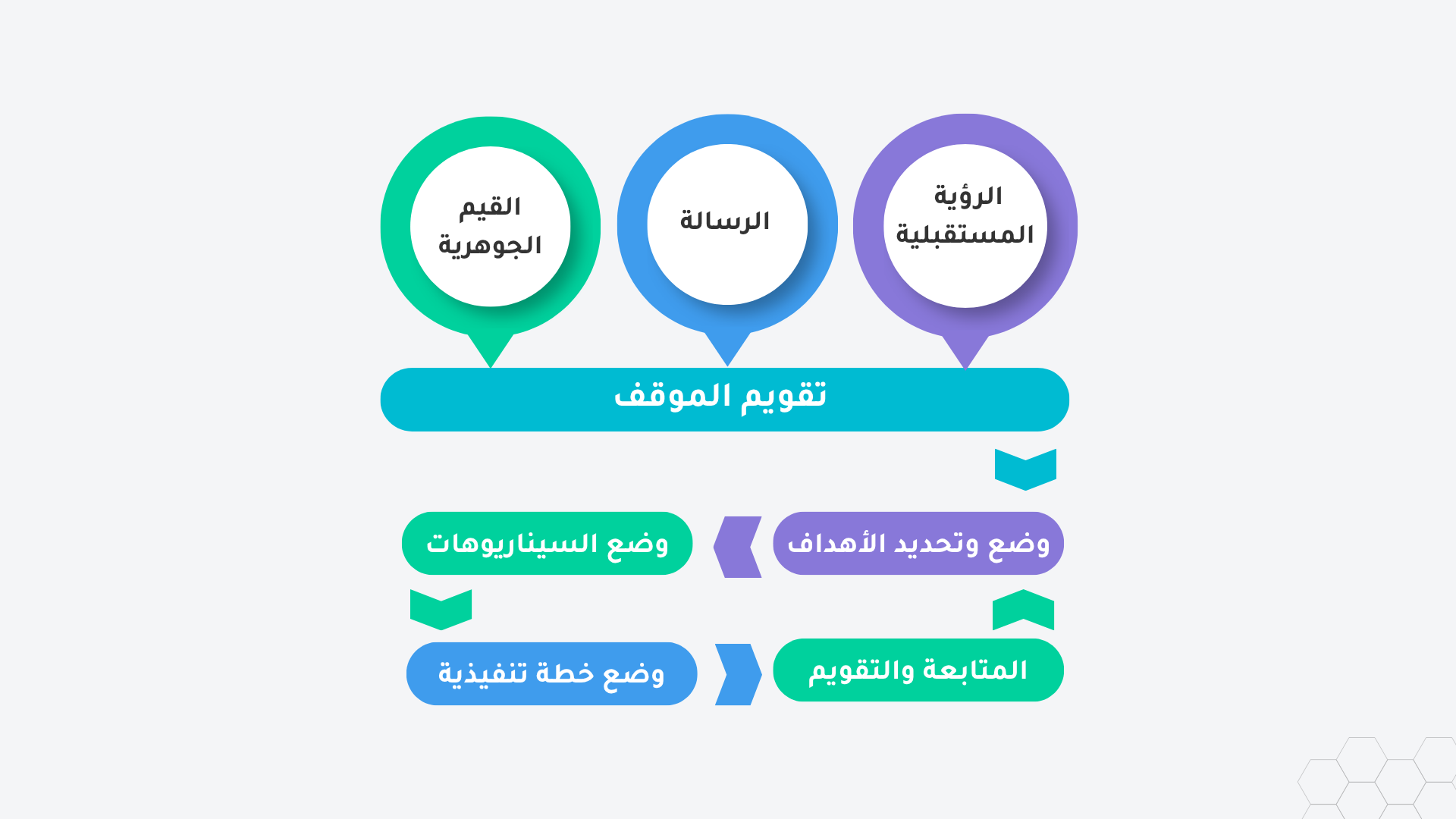
Values embedded in all employees’ mindset; they are an integral part of the organization’s systems. Following them is mandatory, violating them leads to accountability. Each value forms a complete training program.
Relies on studying the current state of the organization, linking training to its needs, and analyzing available data to identify training priorities and formulate clear, actionable training objectives.

Strategic investment in training and developing employees is of utmost importance for achieving the goals of your organization. By nurturing the talents of employees and developing their skills, you not only enhance the culture of your company, but also enable leaders to manage development needs more effectively.
Training and developing employees means committing to continuous enhancement of their skills and performance through a range of programs and activities. The American Bureau of Labor Statistics found that 84.4% of employees in companies with 50 or more employees receive some form of formal training at work, serving multiple purposes, including:
By providing employees with new skills, they not only open up opportunities for professional advancement, but also ensure that work teams are always ready to face new challenges. This continuous learning process enables employees to deliver their best and contribute to the growth of the organization.
Training is focused on specific skills and knowledge required for current roles, often with a short-term perspective. It aims to equip employees with the skills needed to perform their current job effectively.
Adopts a broader and longer-term perspective aimed at preparing team members for future roles and their professional growth. This may include leadership programs, guidance, and mutual training to expand their skill range.
Training and development work together to create a more flexible and future-oriented workforce.
A well-trained team contributes to improving performance, increasing productivity, and stimulating innovation. Companies that implement effective training programs also have higher employee retention rates, as team members feel more committed and appreciated.
For you as an employee, the impact is not less important, as it enhances providing job development opportunities and skill development from the level of commitment and job satisfaction. Through building a culture of continuous improvement, you can provide employees with the tools necessary to achieve their full potential.
The management ensures that training initiatives align with company goals and are implemented effectively. The training and development managers primarily oversee the planning, implementation, and evaluation of programs designed to enhance employee skills and performance. The goal is to create an environment that enables team members to thrive.
Found in Globall, 70% of the team’s diversity is affected by leadership. This means that managers have the ability to determine the direction of employee learning through the relationships they build.
Designing customized training programs that align with work goals, and collaborating with section managers to ensure an attractive and applicable content.
Overseeing the training budget and allocating funds, and making smart decisions to expand the scope of initiatives while maintaining quality.
Presenting major training sessions, especially for basic programs, and helping leaders deliver the material clearly.
Fostering a continuous learning culture and encouraging employees to grow, collaborate, and take responsibility for their educational path.
Ensuring that all training programs comply with industry regulations and company standards, and adhering to legal requirements.
Identifying the skills gap by analyzing employee performance, collecting feedback, and aligning training with work goals.
Setting measurable goals that provide direction and a way to track success, whether focused on leadership or technical skills.
Selecting methods that match the content and employees, such as practical workshops, guidance programs, or online courses.
Creating an environment that encourages employees to absorb new skills and apply them, ensuring easy access and participation.
Tracking progress, collecting feedback, and analyzing results to improve future programs and build a continuous learning culture.
Combining face-to-face sessions, online learning, and practical training to meet different learning styles.
Designing training that matches employee roles and professional goals to ensure fit and interaction.
Linking employees with mentors to lead learning groups and enhance knowledge exchange and skill development.
Creating an environment that encourages employees to provide constructive feedback to improve programs continuously.
Tracking progress using analysis and feedback to improve training and ensure its ongoing effectiveness.
An integrated guide that draws a clear roadmap for everyone who assumes executive leadership responsibility. From defining roles and competencies, to building teams and creating influence.

The CEO is the highest authority in the facility, and he is the authority from which everyone’s powers emanate. He sets the organization’s policies, directions, and strategic plans, makes decisions, solves problems, and performs all four management functions. In addition, it constitutes the interface of the facility and the link between multiple parties.
It represents the link between the directions of the Board of Directors and their operational applications on the ground.
It represents the organization to its clients and strategic partners, and consolidates its mental image in the market.
Planning, organizing, directing, and controlling – all of them are practiced in an integrated and balanced manner.
The powers of all administrative levels are derived from his powers, making him the first decision-making authority.
From his leadership position, the CEO is responsible for achieving a set of interlocking strategic goals that together shape the organization’s identity and competitiveness.
Establishing a clear vision and long-term plans for the facility.
Selecting competencies, developing their performance and constantly raising their productivity.
Formulating the bylaws and regulations that regulate the workflow within the facility.
Redrawing organizational structures and improving processes to achieve maximum efficiency.
Setting quality standards and developing the human resources and service system.
Improving the facility’s image among customers, partners and society.
If goals paint the big picture, then daily duties are the fabric from which that picture is made. Among the most prominent tasks that the CEO performs daily are:
| the duty | Description |
|---|---|
| Follow up on the implementation of goals | Continuous verification of the path to achieving goals and overall performance |
| Keeping up with the changes | Paying attention to changes in the internal and external environment and adapting to them |
| Guidance and supervision | Directly supervising work progress and directing teams towards goals |
| Chairing meetings | Managing working sessions and ensuring effective decisions are produced |
| Postal business | Finalizing official correspondence and ensuring institutional communication |
| Interviewing major clients | Building strategic relationships with decision-makers and influential customers |
| Solve everyday problems | Rapid intervention and addressing operational obstacles to work |
| Review periodic reports | Analyze performance indicators and make appropriate decisions based on them |
Competence is not just a skill that is practiced, but rather an integrated combination of knowledge, behavior, and ability to perform in different circumstances. The following are the most important competencies that a successful executive director needs:
Influence is not just an additional competency, but rather the pivotal competency with which all other competencies intersect. A leader who lacks the ability to influence finds himself faced with a mass of papers and powers without a spirit to move them.
Executive reality does not always resemble what plans and theories depict. The CEO often finds himself facing deep-rooted challenges that require patience, intelligence, and a strong will to overcome.
ancient legacy: Inheriting entrenched work methods and mindsets that resist change.
Sterile structure: Rigid organizational structures that do not serve the objectives of the stage.
Frustrated or conflicted team: The phenomenon of paralysis and internal conflicts that drain energy.
Negative mental image: A negative legacy of the facility in the minds of customers and the public.
Bound HR system: Outdated policies that do not enable attracting appropriate talent.
Bureaucracy of decisions: Long decision cycles slow down response to variables.
Complex procedures: Complex systems and processes burden both employees and customers.
The answer begins with an honest diagnosis of reality before embarking on change. Whoever knows his exact location can clearly plot the exit route.
In his working day, the CEO embodies five overlapping roles, none of which can be completed in isolation. If he mastered all these roles, he would be a complete leader. If he violates any of them, those who work with him will feel it before he feels it.
The role of the CEO in all its paths is based on three fundamental axes: Impact — who inspires the team and creates commitment, andDecision making — which governs the course of the establishment at moments of choice, andProblem solving — who embodies the ability to turn obstacles into opportunities.
“If three people go out on a journey, let them appoint one of them.”
– Narrated by Abu Dawud on the authority of Abu Saeed Al-Khudri, may God be pleased with him
Leadership was never an organizational luxury, but rather a human necessity that Islam recognized before modern management theories discovered it. Leadership is defined as Move people towards the goalIt requires the presence of three indispensable elements:
An outstanding leader can see the world from three heights at the same time, and this ability to move between levels is what distinguishes a true leader from a traditional manager.
Management scientist Douglas McGregor developed his famous theory to classify managerial attitudes toward employees, which is an important starting point for every executive who wants to understand his style of dealing with his team.
The impact of your theory on your leadership behavior is greater than you imagine. A leader who believes in Theory
There are unwritten laws that leaders discover through long experience and practice. Below are the most prominent ones:
If the leader is righteous, the establishment is reformed, and if he is corrupt, then corruption is general. When you notice any deterioration in the conditions of a facility, find the leader first.
You become a role model and those close to you seek to imitate your behaviors, words, and actions. True influence is not measured by position, but rather by what remains of your impact on the souls of those you lead.
Between emotion and logic – between mercy and justice – between work and life – between reward and punishment – between severity and softness – between friendship and position.
Before bringing someone into your inner circle, ask: Does he fit in with the team? Does he have the required qualifications? Is it a real addition?
Learning – Gaining knowledge and experience.
Earning – Achieving results.
Returning — Giving back to the community and facility.
Family – religious – financial – scientific – social – psychological – professional – health. Balancing these axes is the key to sustaining leadership performance.
Common purpose and goal
Real empowerment
Building relationships
Flexibility in dealing
Perfect performance
Appreciation and recognition
High morale
If the leadership dimension shapes the soul, the administrative dimension builds the body. It includes a system of tools and models that transform strategic directions into an executable and measurable operational reality.
The CEO’s scope of work includes all levels of the administrative hierarchy:
The clock and compass are the executive’s basic tools: the first determines the available time, and the second determines the correct direction. Before drawing up plans, it is necessary to accurately diagnose the situation through SWOT analysis:
Before formulating goals, you should know where they come from. No real goal is born out of nowhere, but is derived from:
A smart goal is not just a wish or wish, but rather a condition that makes every goal implementable, measurable, and follow-up. The more SMART the goal is, the higher the chances of achieving it.
It is necessary to differentiate between two types of goals: General objectives It is long-term, non-quantifiable, and relates to senior managementSpecific goals It is short-term, measurable with clear criteria and includes all levels of management.
A successful CEO is not satisfied with one scenario. Creating several scenarios gives him a wider margin of choice in case of surprises, and makes decisions to adapt to changes faster and more confident.
Business Process Reengineering is not just a reduction in employees, but rather a radical journey towards eliminating old methods and exploiting resources for newer and more efficient uses. It is based on three main axes:
One of the most common mistakes executives make is to believe that delegating tasks means giving up authority. In fact, intelligent delegation is the most powerful tool for leadership expansion.
The Pareto Principle (80/20) is useful in understanding how to distribute leadership effort, as it explains that focusing on what creates the greatest impact is the essence of executive effectiveness.
Keep 20% of tasks
Activities can be confidently delegated and assigned to the team
When the delegated person fails to perform the task, it is presented to the manager as a problem that consumes more time than it would have taken him if he had accomplished it himself. There are three reasons for this: mis-selection of the appropriate person, lack of real empowerment, or personal reasons that hinder performance.
As much as delegation is recommended, there are tasks that the CEO should keep to himself and not give up easily:
“O you who have believed, fulfill your contracts”
— Surah Al-Ma’idah, verse 1
The service strategy is not just a brochure or a logo hanging on the office wall, but rather an integrated and distinctive way of providing the service that achieves high benefit for the customer and enhances the mental image of the facility. If you don’t have a service strategy, get one.
Advertisements, promises, and slogans all constitute an implicit price that the establishment promises to the customer, thus raising his expectations. If reality falls short of the level you promised, the result will be a double loss: loss of the customer and loss of trust.
The elements of distinguished service are integrated into a harmonious symphony that is not complete without any of its strings:
Not all customers are equally strategically important, and understanding this distinction determines how effort and resources are allocated:
It is not enough for a successful CEO to manage from behind his desk; the field is where the most accurate and correct decisions are born. Methods for entering the field include:
There are behaviors that are not tolerated in a distinguished service environment, because they destroy in an instant what was built over years:
Building a successful CEO is not complete without a solid human dimension. Ultimately, management is the art of dealing with humans, and every tool, every system, and every decision passes through a human being who carries feelings, expectations, and dignity.
Etiquette is being courteous and behaving respectfully with everyone — clients, colleagues, partners, subordinates, and superiors. The protocol is the diplomatic system that governs the etiquette of relations and negotiation in official contexts.
Looking into the eye of the person being addressed indicates respect and self-confidence, and the Prophet, may God bless him and grant him peace, would not look away until the other person was the one who looked up first.
“It is because of God’s mercy that you were kind to them, and if you had been rude and hard-hearted, they would have dispersed from around you.” – Softness is not weakness, but rather true leadership strength.
“O God, whoever is entrusted with the affairs of my nation and is difficult for them, then be harsh with them, and whoever is entrusted with the affairs of my nation and is kind to them, then be kind to them.” — Gentleness in administration is an acquired mercy.
“The first affection is a fluent face, the second is courtship, and the third is meeting people’s needs.” A smiling face is the first level of true service.
“O you who have believed, fulfill your contracts”
— Surah Al-Ma’idah, verse 1
“God loves that when one of you does a job, he does it well.”
– An honorable hadith about mastery and quality
“The master of the people is their servant while traveling.”
– Narrated by Al-Tabarani and others, regarding the virtue of serving others
Human error is not one homogeneous mass, and justice requires that we differentiate between its types before issuing judgments:
Intentional error: Intentional violation with full awareness of it.
defaulter error: Negligence and laziness led to a mistake.
Mujtahid’s mistake: He tried his best but miscalculated – he’s sorry.
forced error: He made a mistake under pressure of necessity.
The wronged person’s mistake: He was forced to make a mistake.
Error of ignorance: He committed the violation without even knowing it.
To conclude this human dimension, there are golden rules that form the CEO’s conscience and moral compass in every situation he encounters:
A successful CEO is not the one who has the most powers, but rather the one who uses them well to serve the organization and those in it. He is the leader who thinks strategically, works with discipline, deals with humanity, inspires with his influence, and builds with his patience. These fourteen competencies, these laws, and these five dimensions – are not a ready-made recipe, but rather mirrors that help you see yourself clearly, and then develop yourself with will.
Hello. You can ask about training services and certifications, or contact us directly.